
The enterprise AI battlefield has a new champion, and it’s not who you might expect. While tech giants scramble to dominate the artificial intelligence landscape, Salesforce’s completely rebuilt Slackbot has emerged as a fully powered AI agent capable of searching enterprise data, drafting documents, and taking action on behalf of employees—directly challenging Microsoft’s Copilot dominance.
This isn’t just another software update. It’s a strategic repositioning that could reshape how businesses interact with AI in their daily workflows. Let’s dive deep into what this means for enterprise technology and why this battle matters more than you think.
The New Era of Enterprise AI Assistants
Gone are the days when workplace chatbots were simple notification tools. The new Slackbot represents a fundamental transformation into an AI agent that can find information, draft emails, and schedule meetings, all within the Slack platform, according to recent announcements from Salesforce.
What Makes Slackbot Different?
Parker Harris, Salesforce’s co-founder and Slack’s CTO, emphasized this distinction when he stated that Slackbot isn’t just another copilot or AI assistant. The platform has been engineered as what the company calls an “employee super agent”—a central hub designed to coordinate with multiple AI agents across an organization.
The rebuilt assistant includes several groundbreaking features:

- Contextual Intelligence: Slackbot accesses conversations, files, and channels while respecting user permissions
- Cross-Platform Integration: Connects seamlessly with Google Drive, Microsoft Teams, Salesforce, and OneDrive
- Action-Oriented: Moves beyond answering questions to actually completing tasks
- Zero Configuration: No setup required for end users—it learns from existing Slack usage
Microsoft’s Response: The Copilot Evolution
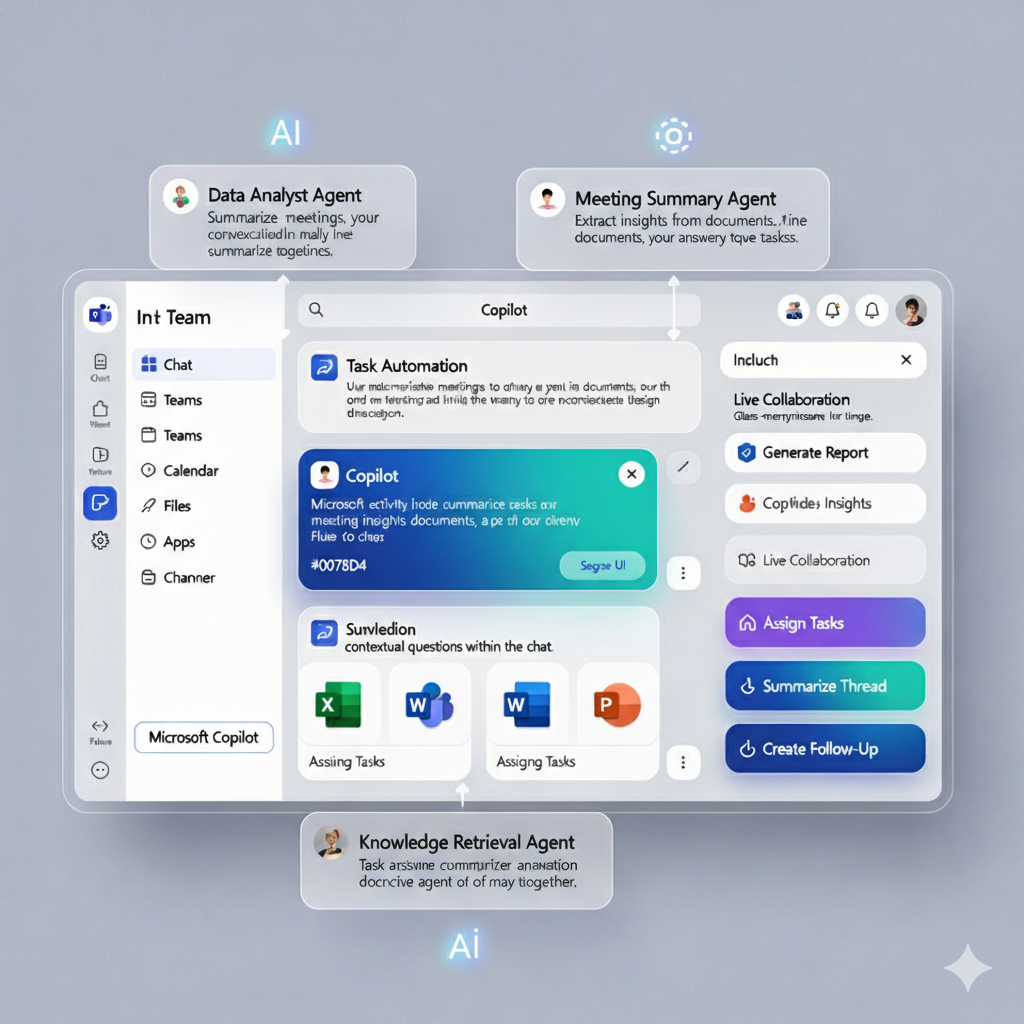
Microsoft hasn’t been sitting idle. The company introduced Teams Mode for Microsoft 365 Copilot, transforming individual AI chats into group conversations in Teams, along with collaboration-focused agents that work across the Microsoft ecosystem.
Microsoft’s Strategic Advantages
Microsoft’s enterprise AI strategy leverages several key strengths:
- Deep Ecosystem Integration: Copilot works natively within Word, Excel, PowerPoint, Outlook, and Teams
- Microsoft Graph Access: Understands organizational structure, email history, and meeting transcripts
- Model Context Protocol Support: Enables third-party agents to interact seamlessly within the ecosystem
- Advanced Agents: Including Facilitator for meetings, Employee Self-Service, and Interpreter for real-time translation
The company’s approach focuses on what industry analysts call “Work IQ”—an intelligence layer that enriches AI experiences with implicit understanding of work patterns, relationships, and workflows.

The Technology Behind the Rivalry
Understanding the technical foundations helps explain why this competition matters:
Salesforce’s Agentic OS Vision
Salesforce has positioned Slack as an “agentic operating system” for enterprises. This vision includes several components:
- Real-Time Search API: Enables developers to build intelligent agents with access to conversational data
- Model Context Protocol Server: Allows partners like OpenAI, Anthropic, Google, and Perplexity to build context-aware agents
- Enterprise Search: Unifies knowledge across integrated systems with natural language queries
- Channel Expert Agent: Provides instant, always-on knowledge within channels
The strategy recognizes something fundamental: conversational data represents the richest source of workplace context, which has historically been locked away in unstructured messages.
Microsoft’s Agent Orchestration
Microsoft’s counter-strategy focuses on agent orchestration across its vast ecosystem. The company has developed what they call a “unified control plane” for enterprise agents through Agent 365, which centralizes governance, policy management, and monitoring.
Key technical capabilities include:
- Multi-Model Routing: Dynamically selects between GPT-5, Claude Sonnet 4, and Gemini 2.5 Pro based on task requirements
- Windows 365 for Agents: Allows creation and deployment of enterprise-grade agents on secure Cloud PCs
- Comprehensive Governance: Real-time protection powered by Microsoft Defender with audit support
- Cross-Application Coordination: Agents can schedule meetings, generate documents, and update CRM records
Real-World Impact: Early Adoption Stories
The proof of any enterprise technology lies in its real-world application. Beast Industries, the parent company of YouTube creator MrBeast, became one of Salesforce’s pilot customers. Their CIO described the implementation as “practically one of the easiest” enterprise technology rollouts he’d experienced in over two decades.

The security review process, typically a major bottleneck for enterprise AI, was completed quickly because Slackbot only accesses information each user already has permission to view—a critical security feature that addresses one of the biggest concerns about workplace AI.
Productivity Gains
Both platforms promise significant productivity improvements:
- Slackbot Users: Report using the assistant to summarize channel feedback, correlate usage data, and create actionable project plans
- Microsoft Copilot Users: Leverage the tool for meeting preparation, document analysis, and cross-application task automation
Salesforce claims Slackbot represents the fastest-adopted feature in the company’s 27-year history, though Microsoft counters with its massive existing Microsoft 365 user base and built-in distribution advantage.
The Competitive Dynamics: Why This Matters
This isn’t just a feature war—it’s a battle for the future of work. Three key factors make this competition particularly significant:
1. Market Position and Strategy
Salesforce acquired Slack for $27.1 billion in 2021, making it the company’s largest acquisition ever. The investment reflects a strategic bet that conversational platforms will become central to enterprise operations. Microsoft, meanwhile, has Teams as a core component of its Microsoft 365 ecosystem, creating a natural distribution advantage.
2. The Pricing Battle
Salesforce offers enhanced Slackbot at no additional cost to Business+ and Enterprise+ customers—a strategic move designed to accelerate adoption. Microsoft 365 Copilot, by contrast, requires a $30 per user monthly license on top of existing Microsoft 365 subscriptions.
However, the competitive landscape shifted when competitors began including AI features in base subscriptions. This pricing pressure represents a significant strategic challenge for both companies.
3. The Developer Ecosystem Play
Both platforms recognize that no single application can meet all enterprise needs. Their approaches to third-party integration reveal different philosophies:
- Slack’s Approach: Open platform with Real-Time Search API and Model Context Protocol support for maximum flexibility
- Microsoft’s Approach: Controlled ecosystem with carefully managed third-party integrations through approved channels
The winner may be determined by which ecosystem attracts more developers and creates more valuable integrations.
Challenges and Limitations
Despite the impressive capabilities, both platforms face significant obstacles:
Security and Compliance Concerns
Enterprise AI deployments must navigate complex regulatory requirements. While both platforms emphasize security, questions remain about:
- Data residency requirements in different jurisdictions
- Audit trail completeness for AI-generated actions
- Liability for AI agent mistakes or inappropriate responses
- Integration security when connecting multiple third-party services
Accuracy and Reliability
AI agents must be accurate when accessing business-critical information. Both platforms address this through:
- Permission-based access controls
- Source citation in responses
- User verification steps for important actions
- Continuous model refinement based on feedback
User Adoption Barriers
Technology capabilities mean little without user adoption. Both platforms face challenges including:
- Change management in large organizations
- Training requirements for effective AI usage
- Integration with legacy systems
- Cultural resistance to AI assistance
The Broader Implications for Enterprise Technology
This competition signals several important trends in enterprise software:
The Shift to Conversational Interfaces
Traditional software interfaces with menus, buttons, and forms may give way to natural language interactions. Both Salesforce and Microsoft envision futures where employees interact with business systems through conversation rather than clicking through complex interfaces.
The Rise of Agentic AI
Moving beyond simple assistants, enterprise AI is evolving toward autonomous agents that can complete multi-step tasks, coordinate with other agents, and proactively identify opportunities for optimization. This represents a fundamental shift in how software operates.
The Importance of Context
The richest AI experiences require deep understanding of organizational context—who works with whom, what projects are active, what decisions were made. Both platforms recognize that conversational data and workplace activity provide this context, making communication platforms strategic assets.
What This Means for Enterprise Decision-Makers
If you’re evaluating enterprise AI solutions, consider these factors:
For Existing Slack Organizations
The enhanced Slackbot offers compelling advantages:
- Zero additional licensing cost for premium tiers
- No configuration required
- Works within existing collaboration workflows
- Respects established permissions and security policies
However, consider whether your organization also needs AI integration with Microsoft Office applications, which might favor a Microsoft-centric approach.
For Existing Microsoft 365 Organizations
Microsoft Copilot provides deep integration across the productivity suite:
- Native functionality in Word, Excel, PowerPoint, and Outlook
- Access to Microsoft Graph data
- Unified experience across applications
- Robust governance and compliance tools
The additional licensing cost is significant, but may be justified by the comprehensive integration if your organization heavily uses Microsoft applications.
For Organizations Evaluating Both
Consider a hybrid approach:
- Use Slack for team collaboration and conversational AI
- Deploy Microsoft Copilot for individual productivity in Office applications
- Evaluate which platform better aligns with your primary workflows
- Test both with pilot groups before full deployment
The Road Ahead: What to Expect
Both Salesforce and Microsoft have ambitious roadmaps for their AI assistants:
Salesforce’s Plans
Upcoming Slackbot capabilities include:
- Meeting booking automation
- AI image generation
- Proactive information surfacing
- Code-free agent creation
- Enhanced integration with Agentforce platform
Microsoft’s Trajectory
Microsoft is developing:
- Expanded language support for Copilot features
- More sophisticated multi-agent coordination
- Enhanced data processing within specific countries
- Desktop and web versions of voice interaction
- Deeper third-party agent integrations
Conclusion: A Competition That Benefits Everyone
The Salesforce versus Microsoft AI battle represents healthy competition that ultimately benefits enterprise customers. As both companies push the boundaries of what’s possible with workplace AI, they’re creating more capable, accessible, and valuable tools for businesses of all sizes.
Slackbot’s transformation from simple notification bot to sophisticated AI agent demonstrates how quickly this technology is evolving. Microsoft’s comprehensive Copilot ecosystem shows the power of deep integration across productivity applications. Both approaches have merit, and both will likely coexist in the enterprise landscape.
The question isn’t which platform will “win”—it’s how businesses can best leverage both to create more productive, efficient, and innovative workplaces. As these platforms continue to evolve, the real winners will be the employees and organizations that embrace AI thoughtfully, integrate it effectively, and use it to augment human capabilities rather than replace them.
The enterprise AI race isn’t over—it’s just getting started. And with Slackbot and Microsoft Copilot leading the charge, the future of work looks more intelligent, more conversational, and more collaborative than ever before.