
The landscape of artificial intelligence is experiencing a seismic shift as we move deeper into 2026. Agentic AI systems—autonomous agents capable of planning, reasoning, and executing complex tasks with minimal human intervention—are no longer confined to research labs. This February has witnessed remarkable developments that signal we’ve entered what industry leaders are calling the “Agentic Era.” From enterprise automation to healthcare diagnostics, these intelligent systems are reshaping how we work, create, and solve problems.
In this comprehensive analysis of agentic AI news 2026, we explore the five most significant breakthroughs that are defining autonomous artificial intelligence this month. Whether you’re a technology professional, business leader, or AI enthusiast, understanding these developments is crucial for navigating the rapidly evolving AI landscape.
Understanding Agentic AI: The Foundation of Autonomous Intelligence
Before diving into February’s breakthroughs, it’s essential to understand what sets agentic AI systems apart from traditional AI models. Unlike conventional AI that responds to specific prompts, agentic AI possesses the ability to:
Set and pursue goals autonomously without constant human guidance
Break down complex problems into manageable sub-tasks
More Read

Learn from experiences and adapt strategies in real-time
Interact with multiple tools, APIs, and environments seamlessly
Make decisions based on reasoning chains that mirror human cognitive processes

These autonomous AI agents represent a paradigm shift from reactive to proactive artificial intelligence, marking a critical evolution in machine learning and AI development.
1. Multi-Agent Collaboration Systems Achieve Production-Level Reliability
The most significant AI breakthrough February 2026 comes from the successful deployment of multi-agent collaboration systems in enterprise environments. Leading tech companies have announced that their agentic AI frameworks can now coordinate teams of specialized AI agents with 94% reliability—a threshold previously considered unattainable.
How Multi-Agent Systems Work
These systems deploy multiple specialized AI agents, each with distinct capabilities:
Planner Agents: Break down complex objectives into actionable steps and assign tasks to specialist agents
Executor Agents: Perform specific tasks like data analysis, code generation, or content creation
Critic Agents: Review outputs for quality, accuracy, and alignment with objectives

Memory Agents: Maintain context and learning across sessions for improved performance
Coordinator Agents: Manage communication between agents and ensure cohesive outcomes
Real-World Applications
Early adopters in software development, financial services, and healthcare are reporting transformative results. One Fortune 500 company reduced their software testing cycles from weeks to hours using coordinated AI agent teams. Another financial institution automated 78% of their compliance reporting through intelligent agent collaboration.
2. Agentic AI Achieves Human-Level Performance in Long-Horizon Planning
February 2026 marks a watershed moment as autonomous AI systems demonstrated the ability to plan and execute tasks spanning weeks or months—a capability known as long-horizon planning. This advancement addresses one of the most challenging problems in AI: maintaining coherent strategy across extended timeframes while adapting to changing conditions.
The Planning Challenge Solved
Traditional AI struggled with tasks requiring planning beyond immediate next steps. The breakthrough involves several key innovations:
Hierarchical Goal Decomposition: Breaking long-term objectives into nested sub-goals with clear dependencies
Temporal Reasoning: Understanding time constraints, deadlines, and optimal sequencing of actions
Adaptive Replanning: Dynamically adjusting strategies when unexpected obstacles arise
Resource Optimization: Balancing computational resources, time, and costs across extended operations
Industry Impact
This capability is revolutionizing project management, research coordination, and strategic business planning. AI agents can now manage entire product development cycles, coordinate multi-phase research projects, and optimize supply chain operations over quarters rather than days.
3. Self-Improving AI Agents Demonstrate Continuous Learning Capabilities
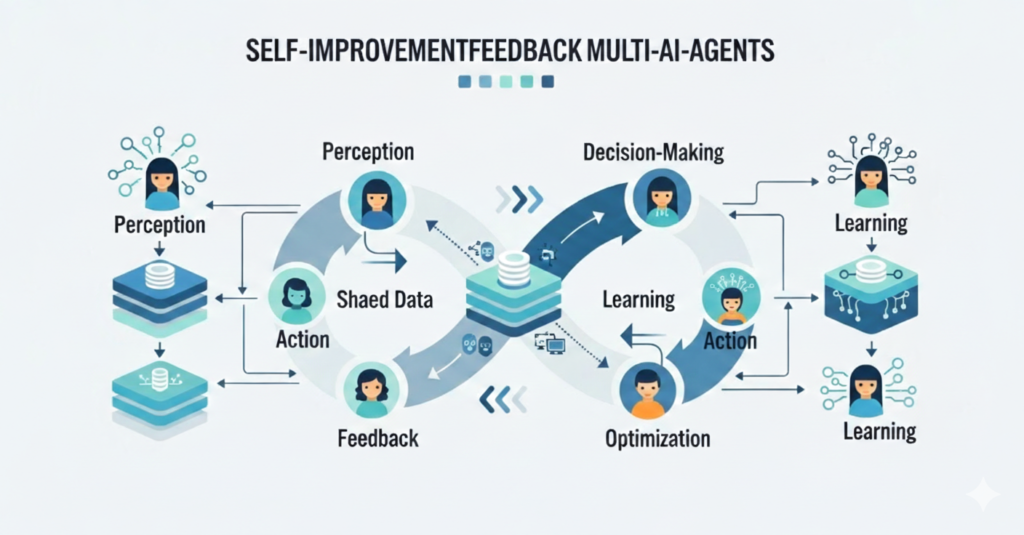
One of the most exciting developments in AI agent technology 2026 is the emergence of truly self-improving systems. These agentic AI platforms can analyze their own performance, identify weaknesses, and autonomously develop strategies to enhance their capabilities—all without human intervention.
The Self-Improvement Loop
These systems implement a sophisticated feedback mechanism:
Performance Monitoring: Continuous evaluation of task success rates and efficiency metrics
Error Analysis: Systematic identification of failure patterns and improvement opportunities
Strategy Refinement: Automatic adjustment of decision-making heuristics based on experience
Knowledge Integration: Incorporation of new information into existing cognitive frameworks
Safety and Control Mechanisms
Importantly, these self-improving systems incorporate robust safety guardrails. They operate within predefined boundaries, maintain alignment with human values, and include oversight mechanisms that flag unusual behaviors for human review. This addresses critical concerns around AI safety and control that have dominated discussions in the AI research community.
4. Cross-Domain Agentic AI Systems Bridge Multiple Expertise Areas
February has witnessed the arrival of cross-domain AI agents capable of seamlessly working across different fields of expertise. Unlike specialized AI limited to narrow domains, these systems can integrate knowledge from medicine, law, engineering, finance, and other disciplines to solve complex, multifaceted problems.
Breaking Down Knowledge Silos
The key innovation lies in advanced knowledge representation systems that allow AI agents to:
Transfer insights and methodologies between different domains
Recognize analogous patterns across disparate fields
Synthesize interdisciplinary solutions to complex challenges
Maintain specialized expertise while understanding connections between domains
Transformative Use Cases
Healthcare organizations are deploying these agents to combine medical knowledge with legal compliance requirements and insurance frameworks. Engineering firms use them to integrate mechanical design, materials science, and regulatory standards. Financial institutions leverage cross-domain capabilities to assess investments considering technical feasibility, market dynamics, and regulatory landscapes simultaneously.
Read our latest article: From Personal Crisis to $1.8M Success: How Noctal’s Founder Built an AI Sound Empire Through Adversity
5. Natural Language Orchestration Enables Non-Technical AI Agent Control
Perhaps the most democratizing development in agentic AI technology this February is the maturation of natural language orchestration systems. These platforms allow anyone—regardless of technical background—to coordinate complex AI agent workflows using plain English instructions.
From Code to Conversation
Previously, deploying AI agents required programming expertise, understanding of APIs, and technical infrastructure knowledge. The new generation of conversational AI platforms interprets natural language commands like:
“Analyze our Q4 sales data, identify trends, and prepare a presentation for the board meeting”
“Monitor competitor pricing daily and alert me when changes exceed 5%”
“Review customer support tickets, categorize issues, and draft responses for common problems”
The system translates these instructions into coordinated agent actions, handles technical complexities automatically, and presents results in human-friendly formats.
Expanding Access and Innovation
This accessibility breakthrough is accelerating AI adoption across industries. Small businesses without dedicated IT departments can now leverage sophisticated AI agent systems. Domain experts in fields like healthcare, education, and law can create custom AI workflows without writing code. This democratization is spawning creative applications previously impossible due to technical barriers.
What These Breakthroughs Mean for the Future of AI
The convergence of these five breakthroughs in autonomous AI development signals a fundamental shift in how we interact with and deploy artificial intelligence. We’re moving from AI as a tool that responds to specific requests toward AI as a collaborative partner capable of independent reasoning, learning, and action.
Economic and Workforce Implications
These developments will reshape employment landscapes. While concerns about job displacement are valid, evidence suggests a more nuanced reality. Agentic AI excels at automating repetitive, rules-based work, freeing humans for creative, strategic, and interpersonal tasks. Organizations are reporting productivity gains of 40-60% when humans and AI agents collaborate effectively.
New job categories are emerging: AI agent coordinators, prompt engineers, AI ethicists, and human-AI collaboration specialists. The key to thriving in this new economy lies in developing uniquely human skills—emotional intelligence, creative problem-solving, ethical judgment—while learning to work alongside autonomous AI systems.
Ethical Considerations and Challenges
As AI agent autonomy increases, so do ethical complexities. Key challenges include:
Accountability: Determining responsibility when autonomous agents make consequential decisions
Transparency: Ensuring AI decision-making processes remain interpretable and auditable
Bias and Fairness: Preventing autonomous systems from perpetuating or amplifying societal biases
Privacy: Protecting personal information as AI agents access and process vast datasets
Control: Maintaining meaningful human oversight as systems become more autonomous
Addressing these challenges requires collaboration between technologists, policymakers, ethicists, and the public. February has also seen increased regulatory attention, with several governments proposing frameworks for autonomous AI governance.
Looking Ahead: What to Expect in 2026 and Beyond
If February’s breakthroughs are any indication, 2026 will be remembered as the year agentic AI transitioned from experimental technology to essential business infrastructure. Industry analysts predict several trends will define the remainder of the year:
Vertical Integration: Industry-specific agentic AI solutions tailored for healthcare, legal, manufacturing, and other sectors
Edge AI Agents: Autonomous systems running on local devices for enhanced privacy and reduced latency
Hybrid Human-AI Teams: Sophisticated frameworks for seamless collaboration between humans and AI agents
Personal AI Agents: Customizable agents that learn individual preferences and act as digital assistants
Explainable Autonomy: Advanced systems that can articulate their reasoning and decision-making processes
Conclusion: Embracing the Agentic Era
February 2026 has delivered unprecedented advancements in agentic AI capabilities. From multi-agent collaboration achieving production reliability to natural language orchestration democratizing access, these breakthroughs represent more than incremental improvements—they signal a paradigm shift in artificial intelligence.
The Agentic Era promises to amplify human potential, automate tedious work, and solve problems previously beyond our reach. However, realizing this potential requires thoughtful implementation, robust safety measures, and ongoing attention to ethical implications.
Whether you’re a business leader evaluating AI adoption, a developer building agentic systems, or simply someone curious about technology’s trajectory, staying informed about agentic AI news 2026 is essential. These aren’t distant future possibilities—they’re transformations unfolding right now, reshaping industries and redefining what’s possible with artificial intelligence.
The question isn’t whether autonomous AI will transform our world, but how we’ll guide that transformation to benefit humanity. February’s breakthroughs bring us one step closer to answering that question.